(Updated 08/12/21: Additional comments from Dr. White have been added to this article.)
Warp drive pioneer and former NASA warp drive specialist Dr. Harold G “Sonny” White
has reported the discovery of an actual, real-world “Warp Bubble.” And,
according to White, this first of its kind breakthrough by his Limitless Space Institute (LSI) team sets a new starting point for those trying to manufacture a full-sized, warp-capable spacecraft.
In an interview, White added that “our detailed numerical analysis of
our custom Casimir cavities helped us identify a real and
manufacturable nano/microstructure that is predicted to generate a
negative vacuum energy density such that it would manifest a real
nanoscale warp bubble, not an analog, but the real thing.” In other
words, a warp bubble structure will manifest under these specific
conditions. White cautioned that this does not mean we are near building
a fully functioning warp drive, as much more science needs to be done (Updated 08/12/21).
“To be clear, our finding is not a warp bubble analog, it is a real, albeit humble and tiny, warp bubble,” White told The Debrief, “hence the significance.”
That solution was lauded for its
elegant mathematics, yet simultaneously derided for its use of
theoretical materials and massive amounts of energy that appeared
virtually impossible to engineer in any practical way.
Over a decade later, this theory
underwent a major shift, when Dr. White, a then NASA-employed warp drive
specialist and the founder of the highly respected Eagleworks
laboratory, reworked Alcubierre’s original metric and put it into canonical form.
This change in design dramatically reduced the exotic materials and
energy requirements of the original concept, seemingly providing
researchers and science fiction fans alike at least a glimmer of hope
that a real-world warp drive may one day become a reality. It also
resulted in the informal renaming of the original theoretical design, a
concept now more commonly referred to as the “Alcubierre/White Warp
Drive.”
Since then, The Debrief has covered a number of physicists and engineers
taking their own stabs at designing a viable warp drive, including an
entire group of international researchers working on a warp drive that
requires no exotic matter.
However, like Alcubierre and White before them, the warp concepts of
these would-be visionaries all still remain theoretical in nature.
Now, it appears the situation has changed.
TIMING IS EVERYTHING, ESPECIALLY AT WARP SPEED
It is often said that timing is
everything. Therefore, it is not surprising that back when Dr. White
began his latest DARPA-funded research into custom Casimir cavities (a
unique, micro-scale structure with all types of promising applications),
he definitely did not expect to stumble upon this potentially historic discovery, particularly one supporting a theoretical concept that has often defined his public persona.
“Some work we’ve been doing for DARPA
Defense Science Office is the study of some custom Casimir cavity
geometries,” explained White at the American Institute of Aeronautics and Astronautics (AIAA) Propulsion Energy Forum in August of 2021, an event attended by The Debrief. “In the process of doing that work, we kind of made an accidental discovery.”
Without going into the complicated
physics behind Casimir cavities and the tantalizing quantum-scale forces
often observed in these unusual structures, it suffices to say that
they are in no way related to warp drive theory or mechanics. At least,
they never had been before. But, says White, it is work that he and his
LSI team are passionate about, and something DARPA believes has a number
of possible applications.
So, whether by pure coincidence or
some sort of personal destiny, it appears that one of the handful of
engineers on the planet who would immediately know what it was he was
looking at when conducting his Casimir cavity research was in the exact
right place at the exact right time to notice a striking similarity to
his warp drive passion project and his current research, an observation
that may have otherwise gone unseen.
“I think this is a great example of
sometimes you are doing work for one reason, and you find something else
you really didn’t expect to find,” said White at the AIAA conference.
Therefore, in this particular case at least, it seems that timing was indeed everything.
PEER REVIEW AND CONFIRMATION OF WARP BUBBLE
“While conducting analysis related to
a DARPA-funded project to evaluate possible structure of the energy
density present in a Casimir cavity as predicted by the dynamic vacuum
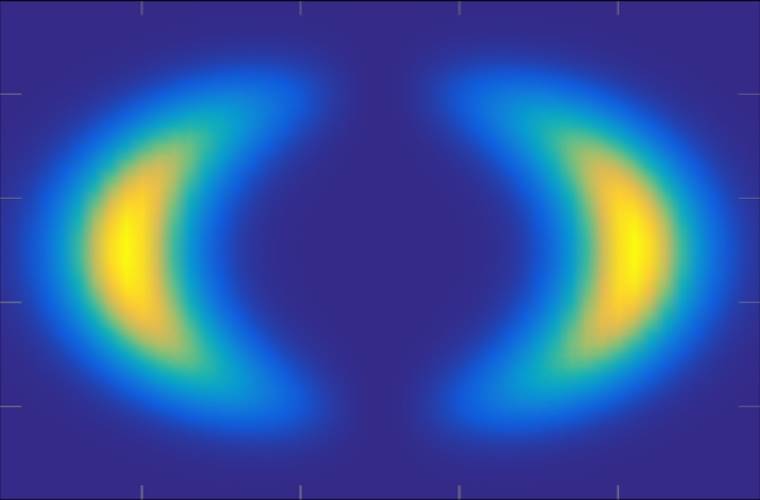
model,” reads the actual findings published in the peer-reviewed European Physical Journal,
“a micro/nano-scale structure has been discovered that predicts
negative energy density distribution that closely matches requirements
for the Alcubierre metric.”
Or put more simply, as White did in a recent email to The Debrief,
“To my knowledge, this is the first paper in the peer-reviewed
literature that proposes a realizable nano-structure that is predicted
to manifest a real, albeit humble, warp bubble.”
This fortuitous finding, says White,
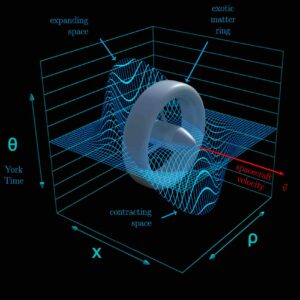
not only confirms the predicted “toroidal” structure and negative energy
aspects of a warp bubble, but also resulted in potential pathways he
and other researchers can follow when trying to design, and one day
actually construct, a real-world warp-capable spacecraft.
“This is a potential structure we can
propose to the community that one could build that will generate a
negative vacuum energy density distribution that is very similar to
what’s required for an Alcubierre space warp,” explained White.
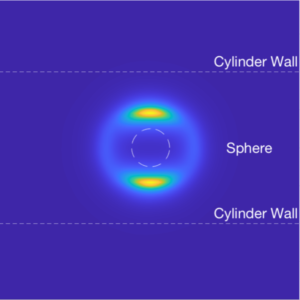
Proposed Design of Nano-Scale Warp craft. Credit LSI
A PROPOSED PATH FORWARD
To further evaluate his
groundbreaking results and move the research forward, White and his team
have come up with a proposed design for a testable, nano-scale “warp
drive craft.”
“Specifically,” said White during the
AIAA presentation, “a toy model consisting of a 1-micron diameter
sphere centrally located in a 4-micron diameter cylinder was analyzed to
show a three-dimensional Casimir energy density that correlates well
with the Alcubierre warp metric requirements.”
“This qualitative correlation,” he
adds, “would suggest that chip-scale experiments might be explored to
attempt to measure tiny signatures illustrative of the presence of the
conjectured phenomenon: a real, albeit humble, warp bubble.”
White expanded further on that idea in yet another email to The Debrief.
“This is a potential structure we can
propose to the community that one could build that will generate a
negative vacuum energy density distribution that is very similar to
what’s required for an Alcubierre space warp.”
When asked by The Debrief
in December if his team has built and tested this proposed nano-scale
warp craft design since that August announcement, or if they have plans
to do so, White said, “We have not manufactured the one-micron sphere in
the middle of a 4-micron cylinder.” However, he noted, if the LSI team
were to undertake that at some point, “we’d probably use a nanoscribe GT
3D printer that prints at the nanometer scale.” In short, they have the
means, now they just need the opportunity.
There is “no plan to do this currently,” explained White, as “we are laser-focused on the custom Casimir cavities.”
Nonetheless, after proposing this
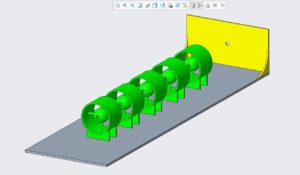
further path for future research, White and his team have also outlined a
second testable experiment that involves stringing a number of these
Casimir-created warp bubbles in a chain-like configuration. This design,
he said, would allow researchers to better understand the physics of
the warp bubble structure already created, as well as how a craft may
one day traverse actual space inside such a warp bubble.
“We could go through an examination
of the optical properties as a result of these little, nano-scale warp
bubbles,” explained White at the AIAA conference. “Aggregating a large
number of them in a row, we can increase the magnitude of the effect so
we can see (and study) it.”
Proposed Warp Bubble Chain. Image Credit LSI
CRAWL, WALK, RUN
Given that DARPA is paying the LSI Eagleworks lab to explore Casimir cavities and not
the accidental discovery of a warp bubble, regardless of its
potentially staggering implications (at least, not yet), it is not
surprising that White and his team remain “laser-focused” on the work at
hand. Plus, given the sometimes secretive nature of work funded by
groups like DARPA, even if White and his team were planning to conduct
the two tests outlined once their current project is completed, it may
not be immediately made public until another significant breakthrough is
cleared for publication.
(Note: White confirmed to The Debrief that
the current DARPA-funded research is not classified, hence his freedom
to publish the warp bubble result. However, the normally forthcoming
researcher was more tight-lipped when asked whether or not any future,
potentially DARPA-funded work on a nano-scale warp bubble spacecraft
might be in the offing once this current work is finished.)
In the end, especially given the
magnitude of this discovery and its potential implications, White
believes it is only a matter of time before his mini-warp craft is
designed and tested, a milestone that he believes will slowly but surely
move the whole process toward the ultimate goal of a warp-capable
spacecraft.
“This discovery allows us to identify a real structure that can be manufactured that will manifest a real warp bubble,” White explained to The Debrief.
When asked by The Debrief how
quickly a successfully-tested nano-scale “craft” like the experimental
one his team proposed could be scaled up to something that can actually
be flown in space, he offered a more realistic approach to this
research, along with an almost poetic piece of hard-earned advice.
“It is early to ask questions about
some type of actual flight experiment,” said White. “In my mind, step
one is to just explore the underlying science at the nano/micro scale,”
before moving toward a larger craft.
Or put more simply, as White did to end that same email, “Crawl, walk, run.”
(Note from the Editor-in-Chief: An update was issued to this
article on 08/12/21 to rectify that Dr. White has discovered a structure
within his Casimir study that would theoretically manifest a warp
bubble under laboratory conditions. The headline was also changed to
reflect this update.)
Follow and connect with author Christopher Plain on